
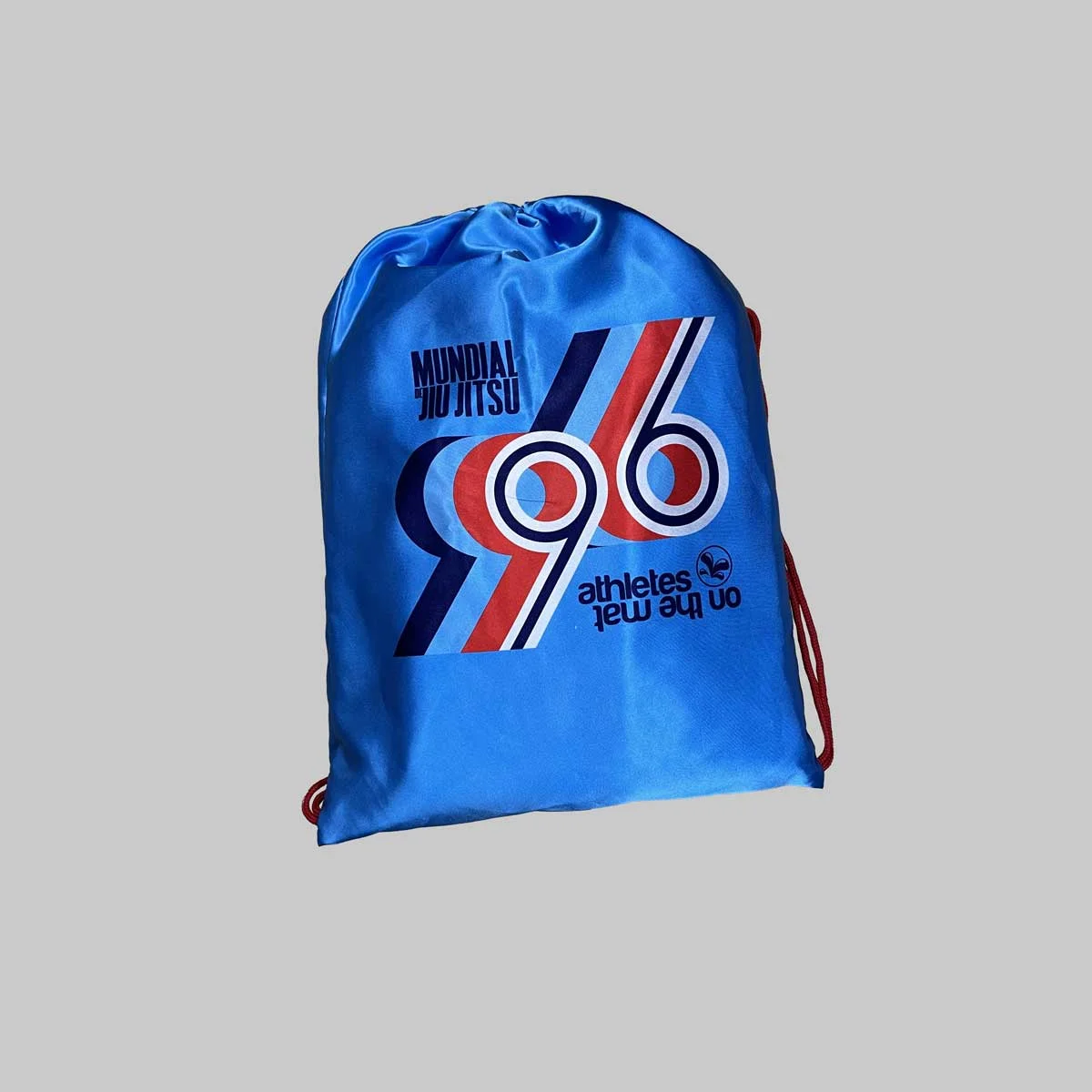
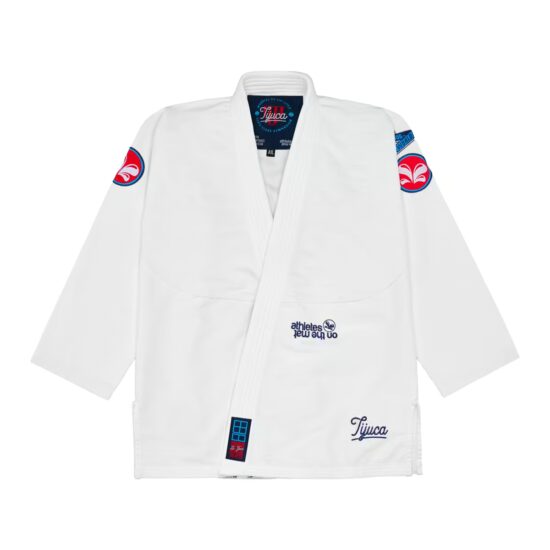
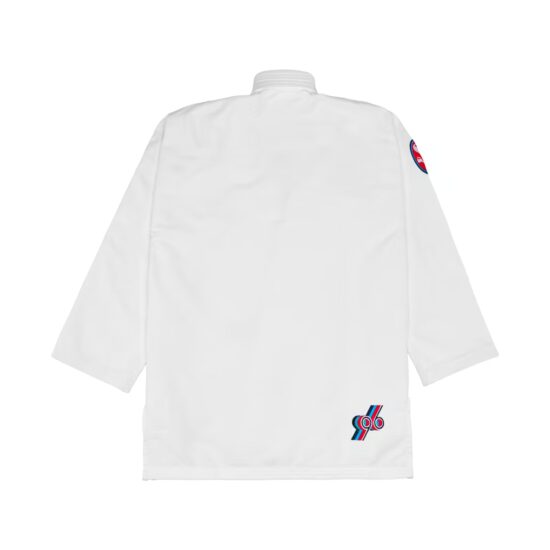
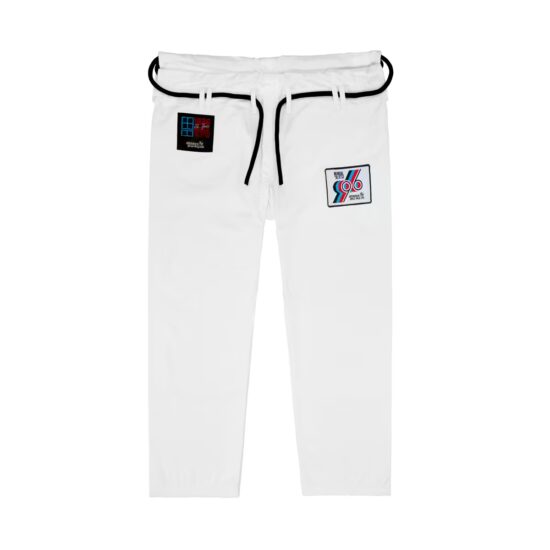
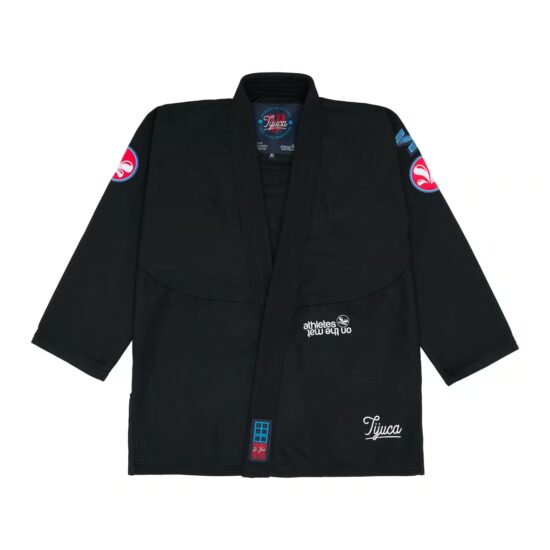
96 Mundial white BJJ gi, 450 GSM
The 96 Mundial white BJJ gi takes its name and its graphics from the first Mundial, held in 1996 at the Tijuca Tênis Clube. A 450 GSM weave, plain white, cut to meet IBJJF rules.
White, and what it asks of you
White is the historic colour of jiu-jitsu, the one you see on Brazilian mats through the nineties. On this model, it is the choice that matches the tribute.
It is also the most demanding colour to own. White shows everything: mat marks, blood, dye bleeding from a new belt. Three habits are enough to keep it presentable for several seasons.
Wash it alone or with whites, never with a recent blue or black gi. Treat stains within the hour rather than at the next wash. Dry in the shade: sun brightens cotton at first, then yellows it.
The details
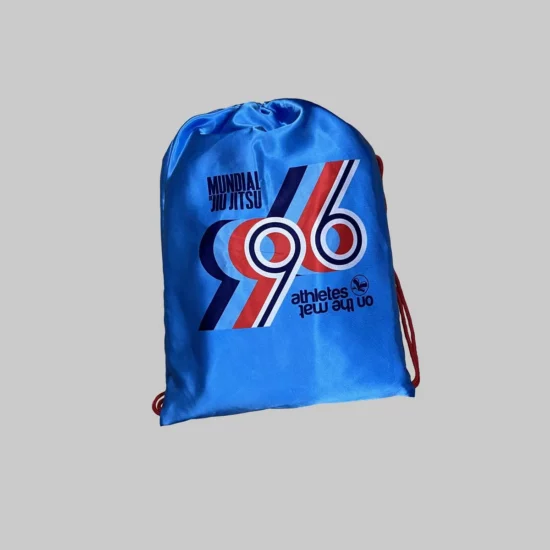
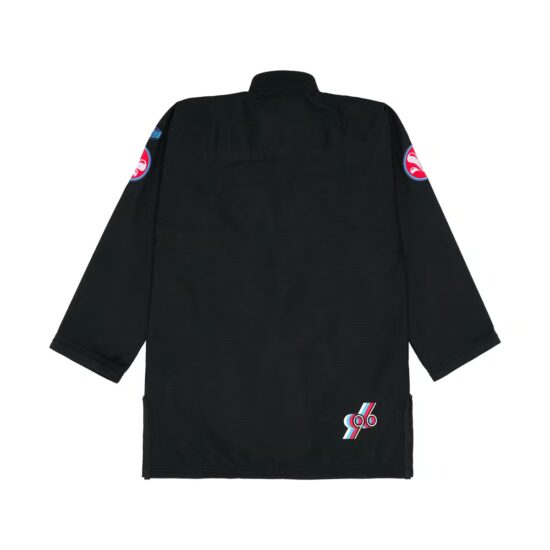
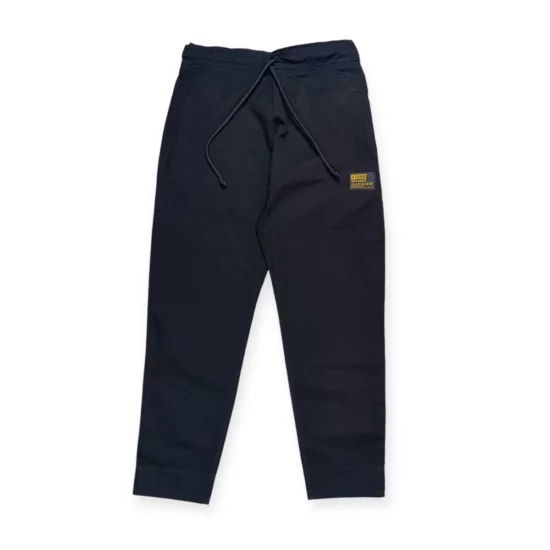
The patches use the mid-nineties palette, blue and red on white. The striped 96 logo appears at the bottom of the jacket back and on the thigh of the pants. The inner collar carries the Tijuca Tênis Clube name, the gym where it all started. The black drawstring is a deliberate break against the white.
450 GSM, the all-round weight
Between a light 380 and a dense 550, 450 is the compromise most people pick when they own a single gi. Thick enough to last and to make grips hard to set, reasonable enough to dry between sessions and not weigh on the scale.
For competition
IBJJF rules allow three colours only, white, royal blue and black, and require the jacket and pants to match. They do here. Officials then check the sleeve measurements, the jacket length and the collar thickness.
Who this gi is for
If you own one gi and train three or four times a week, 450 GSM in white is the default answer. It handles daily use, it clears every uniform check, and no gym will ever tell you it is the wrong colour.
If you compete and watch your weight, look at the 380 instead. If you want a weave that outlasts everything and do not mind the drying time, the 550 sits at the other end of the range.
And if the story matters to you as much as the specification, this is the one: the graphics come from the year the sport got its first world championship.
Sizing, in practice
Gi sizes run from A0 upwards, worked out from height and weight rather than from your usual clothing size. Long cuts exist for anyone tall for their weight. If you fall between two sizes, remember that cotton shrinks slightly over the first washes, and that a jacket which is too long is a reason for refusal at the check-in table.
Size and care
The size finder further down works from your height and your weight. Wash at 30 °C, air dry, never in a tumble dryer. The expected shrinkage is given in the specifications below.
Specifications
- Jacket weight
- 450 GSM
- Jacket weave
- Pearl weave
- Pants weight
- 10 OZ
- Pants weave
- Ripstop
- Reinforcements
- Double : genoux, ouvertures de jupe
- Wrist and ankle stitching
- Triple stitching and reinforced stress points
- Collar
- Mousse EVA
- Pre-shrunk
- Pre-shrunk
- Expected shrinkage
- 3 à 4%
- IBJJF approval
- IBJJF
- Available sizes
- A0, A1, A1L, A2, A2L, A3, A4, F1, F2, F3, F4
- Manufacturing
- Made in Pakistan
- Gi weight in A2
- 1.650 kg
- Care
- Read the guide
Measurements chart
The measurements below are those of the garment, taken flat and after washing. They let you compare with a gi you already own, which remains the most reliable method.
Where the measurements are taken
Sleeve span
Cuff to cuff, jacket laid flat, sleeves extended.
Jacket length
From the base of the collar to the bottom hem, down the centre of the back.
Chest width
Armpit to armpit, jacket laid flat. This is the measurement that determines room across the shoulders.
Pant length
From the top of the waistband to the leg opening, along the outer seam.
Waist width
Width of the waistband laid flat. The drawstring allows adjustment either way.
| Size | Height | Weight | Sleeve spanA | Jacket lengthE | Chest widthB1 | Pant lengthT | Waist widthZ |
|---|---|---|---|---|---|---|---|
| A0 | 150 to 163 cm | 50 to 63 kg | 150 cm | 72 cm | 55 cm | 93 cm | 50 cm |
| A1 | 160 to 173 cm | 62 to 74 kg | 160 cm | 76 cm | 58 cm | 98 cm | 51 cm |
| A1L | 173 to 181 cm | 65 to 75 kg | 167 cm | 78 cm | 59 cm | 100.5 cm | 51 cm |
| A2 | 177 to 183 cm | 77 to 85 kg | 169 cm | 80 cm | 60 cm | 103 cm | 53 cm |
| A2L | 180 to 190 cm | 82 to 92 kg | 173 cm | 82 cm | 62 cm | 105.5 cm | 55 cm |
| A3 | 184 to 195 cm | 88 to 102 kg | 175 cm | 84 cm | 64 cm | 108 cm | 58 cm |
| A4 | 195 to 205 cm | 102 to 130 kg | 183 cm | 88 cm | 67 cm | 113 cm | 61 cm |
The long cuts, A1L and A2L
They keep a width close to the standard size and lengthen the jacket, the sleeves and the pants. They are made for lean builds, at a comparable weight.
For example: at 178 cm and 72 kg, the A1L gives 2 cm more jacket and 2.5 cm more pant length than an A1, without widening the chest.
Between two sizes
Take the smaller one if you are stocky, the larger one if you are lean. If your weight exceeds the range for your height, go for the larger size: room across the shoulders matters more than length.
Still unsure? Send us your height and your weight, we reply the same day.
Garment measurements taken flat, after washing, with a tolerance of plus or minus 2 cm. The cotton is pre-shrunk, slight shrinkage may appear over the first few washes. Wash at 30 degrees, never tumble dry.
THE STORY BEHIND THIS MODEL
The history of jiu-jitsu is built on a handful of extraordinary moments.
Out of that history, we wanted to pay tribute to one moment in particular, the one that changed the 1990s: the first Brazilian jiu-jitsu World Championship, held in 1996 at the Tijuca Tênis Clube.
The “96 Mundial” gi goes back to the roots of that first championship.

Reviews
There are no reviews yet